Presentation of PipingTool
| Name | PipingTool |
|---|---|
| Version | 3.0 |
| Authors | MEUNIER G., KUMMERT M. |
| Licence | MIT |
| Last update | October 2026 |
| Documentation | Wiki |
A tool for sizing and aggregating pipes in thermal networks for three different topologies.
1.1 Overview
PipingTool employs a network formalism inspired by directed graph theory and uses CSV files containing buildings/units load data to size all pipes for three levels of topological accuracy. Following figure provides an overview of the methodology used by this tool.
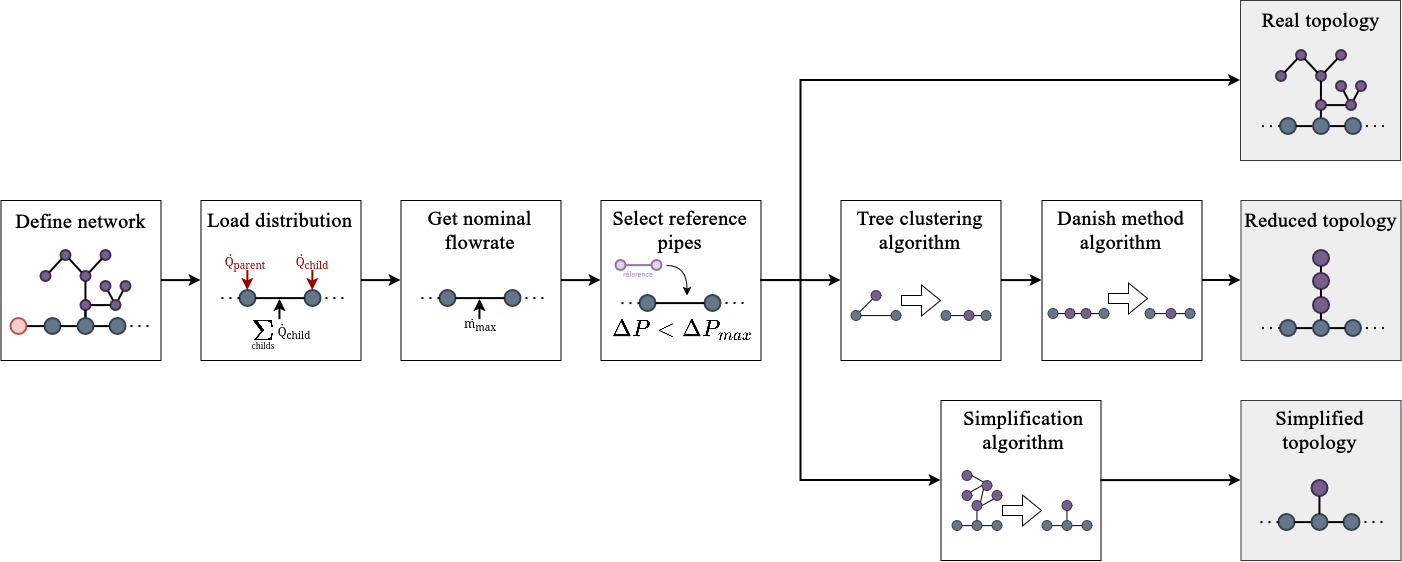
This package have built-in functions for doing
- Defining the network using built-in functions based on graph theory.
- Selecting pipes from a database [1] that satisfy pressure loss constraints (this yields the sizing data for the network’s detailed topology).
- Agregating network using ***simplification method*** based on the calculation of an equivalent node and segment that preserves the sum of loads, pressure drops, and fluid volume.
- Agregating network using ***reduction method*** based on two well-known algorithms for network aggregation: the tree-collapsing algorithm and the Danish method algorithm (Well described by Larsen H. et al[2]).
- Visualization of network topologies.
- Build loads for each network clusters
- Export results for pipe characteristics and cluster loads as CSV files.
See section for methodological details and code documentation.
1.2 Example of network
The following figure shows an exemple of a real network and its two equivalent network for the reduced method and the simplified method proposed in PipingTool.
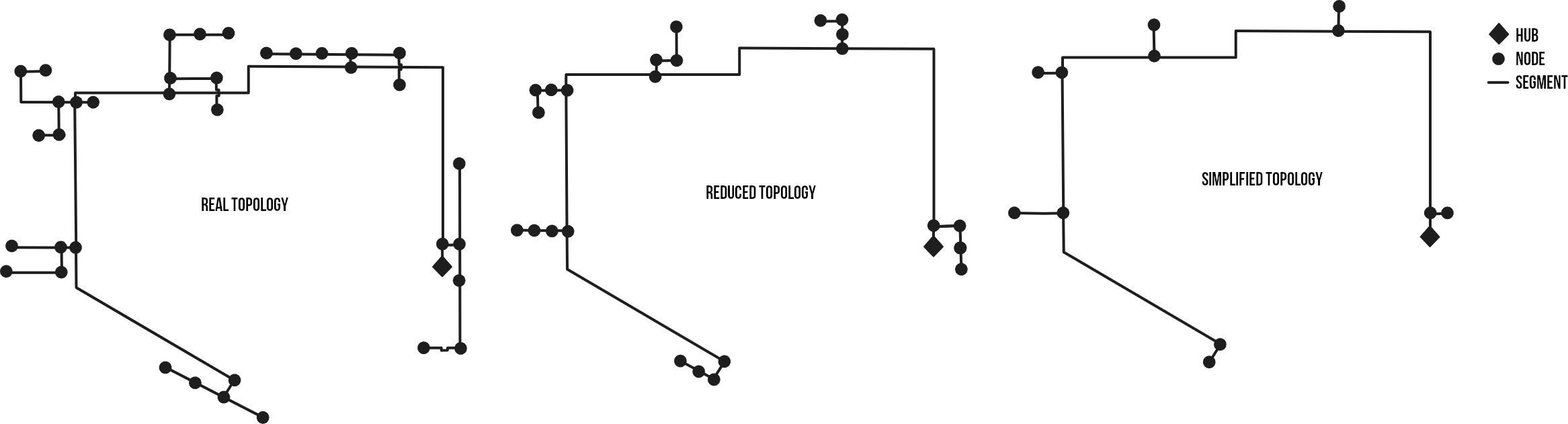
See section for a step-by-step tutorial on how to use the package for this example network.